Welcome to Qingdao ACES
- All
- Product Name
- Product Keyword
- Product Model
- Product Summary
- Product Description
- Multi Field Search
Please Choose Your Language


Views: 0 Author: Site Editor Publish Time: 2026-09-25 Origin: Site


Engineers face a constant dilemma when selecting the right casting method. You must carefully balance upfront tooling capital against per-unit costs and mechanical performance. The stakes are incredibly high for modern manufacturing projects. Choosing the wrong process quickly destroys profit margins. You might over-capitalize on expensive tooling for low-volume production runs. Alternatively, you could incur excessive secondary machining costs on parts needing tighter tolerances. Either mistake severely impacts your commercial viability. This guide provides a purely objective, criteria-driven framework. We will help procurement and engineering teams navigate these complex choices. You will learn exactly which casting process aligns best based on your specific volume, tolerance, and application requirements.
Aluminium sand casting offers the lowest barrier to entry with inexpensive tooling and maximum design flexibility, making it ideal for low volumes, prototypes, and massive geometries.
Aluminium gravity casting (permanent mold) requires higher initial tooling investment but delivers superior surface finish, tighter tolerances, and denser grain structures for pressure-tight applications.
The breakeven ROI point between the two typically falls between 500 and 3,000 units, depending on the part's complexity and post-machining requirements.
Part geometry often dictates the process: heavy, thick-walled parts lean toward sand, while thin-walled, pressure-bearing components lean toward gravity.
Understanding the financial breakeven point requires analyzing two primary factors. You must weigh capital expenditure (CapEx) against operational expenditure (OpEx). Initial tooling investments differ significantly between these processes. Wooden or resin matchplates serve as the primary tooling for sand casting. These patterns cost a fraction of what permanent molds cost. CNC-machined steel or iron molds are required for gravity casting. Manufacturing these steel molds demands extensive machine time and specialized engineering. This drives up the initial CapEx substantially.
However, gravity casting quickly yields a lower piece price at scale. Steel molds allow for faster cycle times. Operators spend less time manually preparing the mold for each pour. Sand molds must be destroyed and rebuilt for every single casting. This manual prep work increases labor costs per unit. Once you reach higher production volumes, the faster cycle times of gravity casting offset its expensive tooling.
You must also consider the machining allowance tax. Many engineers overlook this hidden cost during initial evaluations. Sand casting naturally produces looser as-cast tolerances. To achieve precise mating surfaces, you must add extra material to the initial design. CNC machines then remove this excess material later. This secondary processing heavily impacts the total landed cost of custom aluminium casting parts. Extra machining increases cycle times, consumes cutting tools, and slows down your overall supply chain.
Casting Process Volume Threshold Chart
Estimated Annual Usage (EAU) | Recommended Process | Primary Financial Driver |
|---|---|---|
1 to 499 units | Sand Casting | Minimizes initial CapEx risk. |
500 to 2,999 units | Evaluate Complexity | Calculate secondary machining costs. |
3,000+ units | Gravity Casting | Lower OpEx offsets high tooling costs. |
The thermodynamic behavior of the mold directly determines the final mechanical properties. Sand acts as a thermal insulator. This insulation forces the molten metal to cool slowly. Slower cooling rates produce coarser grain structures in aluminium sand casting. Coarse microstructures typically result in slightly lower tensile strength and reduced fatigue resistance.
Conversely, steel molds conduct heat rapidly away from the molten metal. This rapid thermal transfer provides a significant metallurgical advantage. The fast cooling rate gives aluminium gravity casting a much finer microstructure. A fine grain structure inherently improves the mechanical properties. You gain higher ultimate tensile strength and improved yield strength. These improvements make gravity casting ideal for demanding structural applications.
Porosity types also differ based on your chosen process. Sand molds often contain moisture and organic binders. These materials release gases when exposed to molten aluminium. Gas porosity becomes a tangible risk. Permanent molds eliminate most gas-producing organics. However, they remain susceptible to shrinkage porosity if not gated correctly. You must carefully assess these risks for parts requiring hermetic sealing. Fluid containment applications usually perform better in permanent molds due to the denser, tighter grain structure.
Dimensional accuracy varies widely between these two methods. Industry-standard linear tolerances highlight this difference clearly. Sand casting typically falls under ISO 8062 CT10-12 standards. This allows for wider dimensional variations across the part. Gravity casting routinely achieves ISO 8062 CT7-9 standards. You get much tighter as-cast tolerances straight out of the mold. Tighter tolerances reduce the need for downstream CNC machining operations.
Surface roughness represents another critical evaluation point. Sand casting leaves a visibly textured finish. The surface typically measures between Ra 12.5 and 25 µm. You can easily feel the gritty texture of the sand imprint. Gravity casting produces a remarkably smoother finish. The metallic mold faces leave a surface measuring Ra 3.2 to 6.3 µm. This smoother finish often meets cosmetic requirements without further mechanical polishing.
Despite looser tolerances, sand molds offer unmatched geometric freedom. You can utilize complex, destructible sand cores. These cores allow you to form intricate internal cavities. Once the metal solidifies, you simply shake or wash the sand out. You cannot easily achieve these complex internal geometries in permanent steel molds. Solid steel cores cannot be extracted from intricate undercuts or non-line-of-sight cavities. This makes destructible cores a unique advantage for specific geometries.
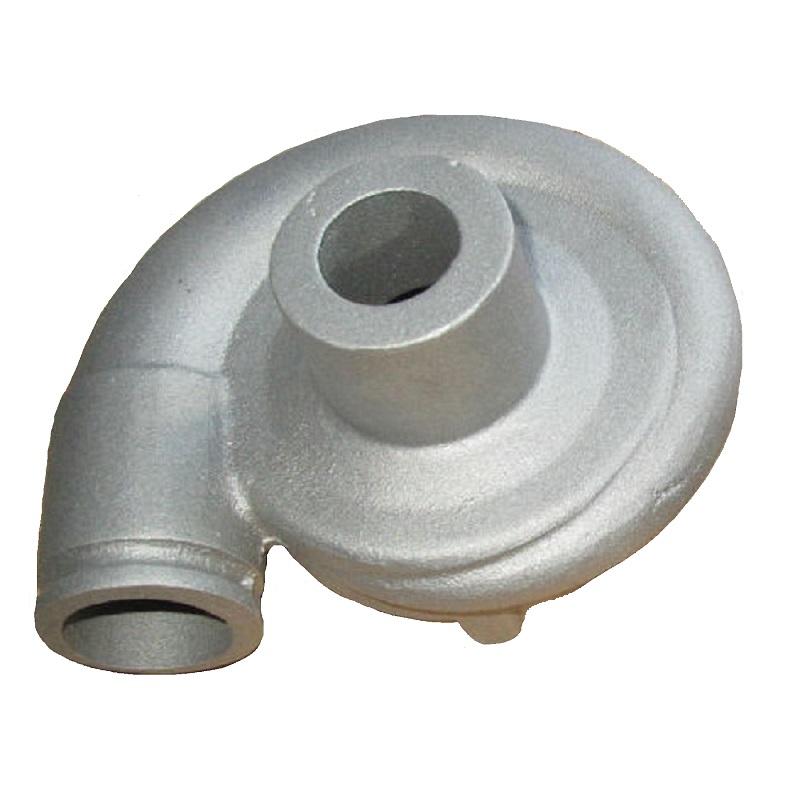
Choosing the correct method often depends on the specific component function. Consider when to specify an aluminium pump casing. Large industrial fluid-handling housings typically default to sand casting. They require massive overall sizes. They also feature complex internal volutes. Destructible sand cores handle these internal fluid paths perfectly. The massive size would make a permanent steel mold prohibitively expensive.
Alternatively, consider when to specify an aluminium fuel pipe part. Gravity casting is strictly preferred for automotive and aerospace fuel lines. These components demand extreme pressure-tightness. They require fine microstructures to prevent catastrophic failures. The dense grain structure guarantees zero leakage risk. Safety-critical fluid transfer cannot tolerate the gas porosity risks associated with sand molds.
General enclosures require a more balanced evaluation. Deciding on a standard aluminium casing depends purely on cosmetic and structural requirements. If the casing remains hidden and mounts simply, sand casting saves money. If the casing faces the consumer or requires precise structural mounting points, gravity casting becomes necessary. Evaluate the visual expectations before making a final decision.
Moving from prototyping to full production introduces significant validation risks. We strongly advise against cutting expensive steel gravity molds immediately. You must ensure the design is fully validated first. Design changes to a steel mold cost thousands of dollars. They also delay production by weeks. We recommend validating your part geometry via sand casting initially. You can test form, fit, and function cheaply. Once validated, you can safely invest in permanent tooling.
Tooling lifespan represents another critical supply chain factor. Wooden and resin sand patterns endure wear and tear relatively quickly. They might last for a few thousand cycles before needing refurbishment. The abrasive nature of sand degrades the pattern details over time. Steel permanent molds offer exceptional longevity. They routinely survive tens of thousands of cycles. You only need routine maintenance to keep them operational.
Lead time realities often dictate the initial project direction. Sand casting tooling gets you to market faster. You can expect lead times of 2 to 4 weeks for initial samples. Pattern making is relatively straightforward. Gravity mold design requires complex thermal analysis. Machining the steel mold and optimizing the gating system takes time. Set your expectations for 6 to 10 weeks before seeing the first gravity cast samples.
Use this straightforward framework to shortlist your process selection. Following these steps prevents costly manufacturing misalignments.
Step 1: The Volume Check. Determine your Estimated Annual Usage (EAU). Is your EAU under 1,000 units? Lean toward sand. Is it over 3,000 units? Lean toward gravity.
Step 2: The Mechanical Check. Evaluate the application stress. Does the part hold pressurized fluid? Does it require high fatigue resistance? If yes, lean heavily toward gravity.
Step 3: The Geometry Check. Look at the internal features. Does the design require massive, non-line-of-sight internal cavities? If yes, lean toward sand.
Actionable Next Step: Prepare a comprehensive data package for your foundry. You need a clean 3D CAD model. You must provide 2D drawings highlighting critical tolerances. Specify the exact alloy designation and your projected EAU. Presenting this data ensures you get an accurate Design for Manufacturing (DFM) review.
Neither process is universally superior across all industrial applications. The "best" process is strictly a function of your part's commercial lifecycle and structural demands. We reiterate the importance of objective decision-making. Pushing a low-volume part into gravity casting wastes precious capital. Keeping a high-volume part in sand casting leaks margin through continuous machining. Submit your 3D models and EAU targets to a specialized engineering team today. A professional review will calculate the exact ROI breakeven point for your specific project.
A: No, you cannot achieve parity in the as-cast state. Sand casting naturally produces a rougher, textured surface due to the sand granules. Achieving a surface finish comparable to gravity casting requires secondary operations. You must utilize bead blasting, mechanical tumbling, or CNC machining. These secondary finishing steps add both time and cost to the final part.
A: Both processes commonly pour industry-standard alloys like A356 and 319. These alloys offer excellent fluidity and castability. However, the resulting mechanical properties will differ significantly. The rapid cooling rate of permanent molds refines the grain structure of A356. This yields higher strength and ductility compared to pouring the exact same alloy into an insulated sand mold.
A: Yes, this hybrid approach is called semi-permanent mold casting. It allows you to place destructible sand cores inside a reusable steel mold. This offers an excellent middle ground. You can manufacture complex internal cavities while maintaining a high-strength, smooth outer shell. It is frequently used for automotive fluid components requiring intricate internal routing.


