Welcome to Qingdao ACES
- All
- Product Name
- Product Keyword
- Product Model
- Product Summary
- Product Description
- Multi Field Search
Please Choose Your Language


Views: 0 Author: Site Editor Publish Time: 2026-06-11 Origin: Site


The automotive manufacturing landscape is undergoing a radical transformation. Strict global emissions standards and the exponential rise of electric vehicles mandate aggressive vehicle lightweighting. Engineers must achieve this mass reduction without sacrificing structural integrity or passenger safety.
Finding the right manufacturing process to meet these demands is notoriously difficult. Automakers face intense pressure to produce complex, high-strength components rapidly. They need a proven, scalable solution that balances high-volume production speed with intricate geometric requirements. High-pressure aluminum casting answers this call perfectly.
We will explore how specific aluminum alloys and advanced molding techniques solve these complex challenges. You will learn how to evaluate manufacturer capabilities and navigate potential implementation risks. This guide provides engineering and procurement teams with a clear framework for specifying materials and successfully sourcing reliable automotive components.
Weight vs. Strength: Aluminum offers a high strength-to-weight ratio, reducing vehicle weight by up to 30-40% compared to cast iron alternatives.
Material Specificity: Alloy selection (e.g., A380, A356, A360) directly dictates thermal conductivity, corrosion resistance, and structural viability.
Compliance is Mandatory: Viable manufacturing partners must demonstrate verifiable IATF 16949 compliance and advanced non-destructive testing (NDT) capabilities.
Risk Mitigation: Upfront investment in Mold Flow Analysis (MFA) and vacuum die casting drastically reduces downstream porosity and tooling failure.
Automakers face intense and competing pressures today. They must reduce total vehicle mass to improve fuel efficiency and battery range. Concurrently, they have to maintain exceptional crashworthiness and optimal thermal management. All of this must happen under strict per-unit cost caps at massive production volumes. Solving this business problem requires highly efficient manufacturing methods.
High-pressure die casting (HPDC) consistently outperforms alternative methods for mass-market automotive parts. Sand casting offers flexibility but fails to deliver the rapid cycle times needed for automotive volumes. CNC machining provides incredible precision but becomes financially unviable when scaling to hundreds of thousands of units. HPDC fills this gap. It delivers near-net-shape components at breakneck speeds while holding tight dimensional tolerances across thousands of cycles.
Procurement teams must carefully analyze the cost-to-volume ratio. Initial tooling costs for high-quality steel molds demand significant capital expenditure (CapEx). However, Custom Aluminum Die Casting Parts offer a phenomenal return on investment. As production volume scales past 10,000 units, the operational expenditure (OpEx) per part drops rapidly. The process amortizes the tooling cost over a massive unit count, keeping final component prices exceptionally low.
Part consolidation presents another massive strategic advantage. Engineers routinely use custom die casting to redesign assemblies. They can integrate multiple stamped, forged, or welded components into a single complex part. This design methodology drastically reduces downstream assembly labor. It also eliminates numerous structural fail points, creating a stronger, more reliable vehicle architecture.
The modern vehicle relies on a vast network of highly engineered metal components. High-pressure casting serves several critical automotive ecosystems.
EV Battery Housings & Enclosures: The shift to electric mobility makes these components crucial. They require robust electromagnetic interference (EMI) shielding to protect sensitive electronics. They also demand rapid thermal dissipation to prevent battery degradation. Manufacturers must meet strict IP67 or IP68 sealing requirements to protect sensitive lithium-ion cells from moisture and road debris.
Powertrain & Engine Components: Internal combustion engines still rely heavily on lightweight aluminum. Factories cast engine blocks, cylinder heads, and transmission cases using this method. These parts face extreme thermal stress and intense mechanical loads. Dimensional stability in these environments remains non-negotiable.
Structural & Chassis Components: Automotive engineers actively transition toward structural integrations. Factories routinely cast shock towers, subframes, and steering knuckles. We also see a massive industry shift toward "megacasting." OEMs now cast entire rear or front vehicle underbodies as single massive components, replacing dozens of smaller parts.
Brackets, Mounts, and Heat Sinks: Vehicles require hundreds of supporting components. These high-volume parts need tight dimensional tolerances to ensure proper mating during assembly. Die Casting Parts for Automotive applications like heat sinks also require rapid heat transfer capabilities to protect delicate sensors and LED lighting matrices.
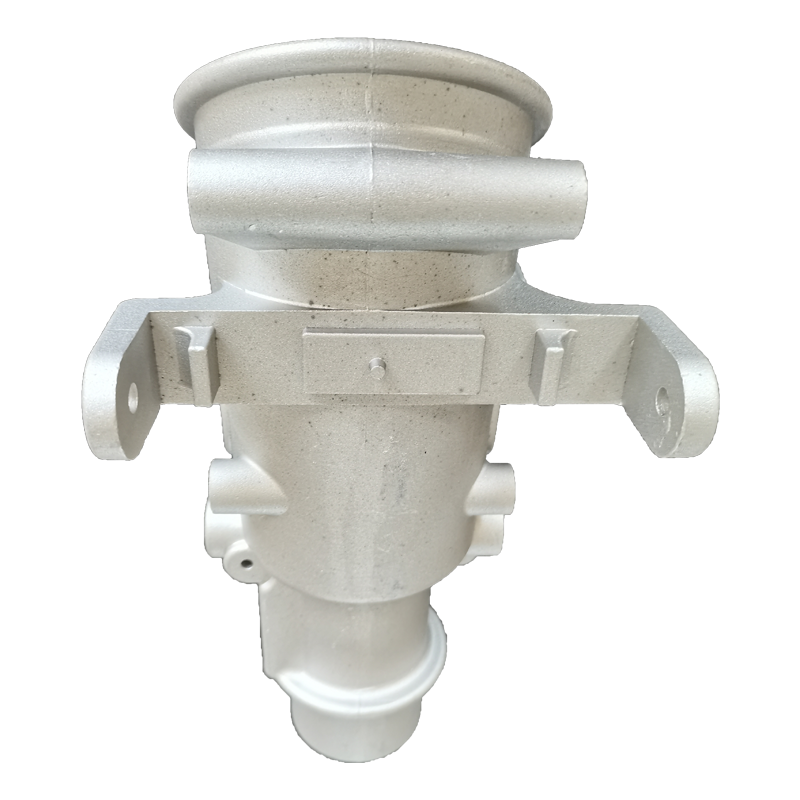
Specifying the correct aluminum alloy determines the success or failure of an automotive component. Each alloy brings a unique chemical composition. These subtle differences dictate the metal's thermal conductivity, corrosion resistance, and structural viability.
A380 (The Industry Standard): This alloy dominates automotive casting floors. It offers the best overall combination of casting ease, mechanical strength, and thermal conductivity. Engineers frequently specify A380 for engine brackets, transmission cases, and complex gearboxes.
A356 (High Strength & Ductility): Some components require extreme crashworthiness. A356 excels here. It provides excellent ductility and responds beautifully to secondary heat treatments (T6). Manufacturers use it extensively for structural chassis parts like steering knuckles and suspension arms.
A360 (Maximum Corrosion Resistance): Vehicles face harsh environments. Road salts and moisture destroy unprotected metals. A360 provides superior corrosion resistance due to its distinct silicon and magnesium ratios. It serves perfectly for exterior parts or exposed undercarriage housings.
A413 (Pressure Tightness): Liquid systems demand absolute leak-proof integrity. A413 flows exceptionally well into complex molds. It creates highly intricate details and maintains strict pressure tightness. Engineers utilize A413 for hydraulic cylinders, pump housings, and fluid transfer systems.
The following table summarizes the primary applications and strengths of these vital alloys:
Alloy Grade | Key Characteristic | Ideal Automotive Application | Post-Casting Heat Treatment |
|---|---|---|---|
A380 | Excellent balance of strength and castability | Transmission cases, engine brackets | Rarely required |
A356 | High ductility and impact resistance | Chassis components, shock towers | Yes (T6 Heat Treatment) |
A360 | Superior corrosion resistance | Exposed undercarriage parts, sensor housings | Rarely required |
A413 | Exceptional pressure tightness | Hydraulic cylinders, fluid pumps | Rarely required |
Sourcing automotive components requires rigorous vetting. You must assess a manufacturing partner's technical infrastructure and quality control frameworks before cutting steel for molds.
First, evaluate their tonnage and equipment scale. Assess the partner's machine matrix carefully. Die casting machines typically range from 400 to over 4000 tons of locking force. You must match the machine's locking force capability to your part's size and cavity requirements. A 400-ton machine easily handles small heat sinks. Conversely, structural subframes require massive 3000-ton machines to hold the mold shut under intense injection pressures.
Second, scrutinize their precision machining integration. Raw castings rarely achieve the critical tight tolerances required for modern automotive mating surfaces. Check if they have robust in-house CNC machining capabilities. They must consistently achieve tight tolerances (e.g., ±0.01mm) on critical sealing faces. Relying on third-party machine shops introduces massive logistical risks.
Third, audit their defect management protocols. Producing Aluminum Die Casting Parts involves turbulent metal flow. This inherently risks trapping air. Look for specific non-destructive testing (NDT) capabilities:
Vacuum-Assisted Casting: Extracts air from the mold cavity before injection, drastically reducing internal porosity.
X-ray Inspection: Detects internal voids and structural inconsistencies hidden beneath the part's surface.
CMM Verification: Coordinate Measuring Machines physically map the part's geometry to ensure absolute dimensional accuracy.
Helium Leak Testing: Verifies the pressure-tight integrity of fluid housings and battery enclosures.
Finally, demand the right quality certifications. An ISO 9001 certificate proves a company has basic management systems. However, it remains insufficient for automotive supply chains. Verifiable IATF 16949 certification acts as the baseline requirement. It guarantees stringent automotive traceability, rigorous risk management, and continuous defect prevention.
Moving from a CAD model to mass production involves significant risk. Engineering teams must anticipate common manufacturing hurdles to prevent costly delays.
Tooling design and lead times require realistic expectations. Creating high-quality H13 steel molds takes time. You should budget 4 to 8 weeks for mold design, Design for Manufacturability (DFM) reviews, and first-article inspection (FAI). Warn your procurement teams against suppliers promising magically fast lead times. Rushing mold creation almost always results in premature tool failure or severe dimensional inaccuracies.
We must have a transparent discussion about porosity and warpage. Some level of porosity remains inevitable in high-pressure processes. The goal is not zero porosity. The goal is managing it. Elite engineering partners control exactly where porosity occurs. They use advanced gating and overflow designs to push trapped gases into non-critical zones. They keep voids far away from critical machining faces or sealing boundaries.
Minimum Order Quantities (MOQs) also pose a challenge. You must align your prototyping needs with the constraints of mass production. Assess suppliers based on their tooling flexibility. Some partners offer soft bridge tooling for low-volume functional testing. They then transition you to hardened multi-cavity production tooling once you validate the design.
Finally, plan for surface treatment compatibility. Automotive parts frequently require secondary finishes like shot blasting, anodizing, or protective powder coating. These treatments add microscopic layers or remove trace amounts of material. Engineers must account for these dimensional shifts during the initial CAD design phase. Ignoring this leads to parts failing assembly line fitment tests.
Narrowing down your supplier list requires proactive testing of their engineering capabilities. Do not base decisions solely on a low initial quote. Instead, stress-test their operational competence.
Begin by auditing their DFM process. A trustworthy supplier will actively challenge your CAD models. They will not blindly cut steel. They will recommend improvements for draft angles to ensure smooth part ejection. They will suggest uniform wall thicknesses to prevent uneven cooling and warpage. They will carefully analyze and reposition gating locations to optimize molten metal flow.
Next, request highly specific case studies and traceability data. Demand verifiable data on their defect rates. Ask for their Parts Per Million (PPM) failure metrics from previous automotive contracts. A reliable partner will confidently share their tool life guarantees. They should easily provide documentation proving they routinely hit 100,000 shots on similar steel molds.
Sourcing high-performance automotive components requires a delicate balancing act. Procurement and engineering teams must weigh initial tooling investments against long-term unit cost efficiency. They must demand rigorous quality control and verify advanced NDT capabilities to ensure vehicle safety.
Successful procurement always relies on Early Supplier Involvement (ESI). Engaging an experienced manufacturing partner during the initial design phase locks in manufacturability. It prevents costly redesigns and dramatically accelerates your time to market. By understanding alloy properties, machine tonnages, and defect management, you mitigate massive downstream risks.
Take the next logical step in your product development cycle. Submit your current CAD files for a comprehensive technical DFM review. Schedule a consultation with a dedicated automotive casting engineering specialist today to validate your component strategy.
A: Standard H13 steel molds typically last between 50,000 and 100,000 shots. The exact lifespan depends heavily on the specific aluminum alloy's melting temperature and the overall complexity of the part design. Highly abrasive alloys or extremely intricate geometric cavities will degrade the mold steel faster, requiring earlier maintenance or replacement.
A: Standard high-pressure die castings are generally not easily welded or heat-treated due to trapped gas causing internal porosity. Heating these parts causes the trapped gases to expand and blister the surface. However, specialized processes like vacuum die casting combined with specific alloys, such as A356, successfully allow for T6 heat treatment and structural welding.
A: CNC machining offers superior precision and zero tooling costs, making it ideal for low-volume prototypes. Conversely, die casting vastly outperforms machining for high-volume production. It relies on economies of scale and extremely rapid cycle times to lower unit costs. Manufacturers typically use CNC only as a secondary finishing step on precision cast parts.
A: Standard casting tolerances generally follow NADCA guidelines, typically achieving ±0.002 inches per inch. Tighter tolerances require secondary CNC machining operations on critical mating surfaces or sealing areas to meet rigorous automotive performance standards. Always clarify which surfaces require post-machining during the initial design phase.


